Showing posts with label Plant science. Show all posts

Friday, September 22, 2017

Ensuring broccoli sprouts retain their cancer-fighting compounds

Raw broccoli sprouts, a rich source of potential cancer-fighting compounds, have become a popular health food in recent years. But conventional heat treatment used to kill bacteria on produce can reduce levels of the broccoli sprouts' helpful phytochemicals. Now researchers report in ACS' Journal of Agricultural and Food Chemistrythat high pressure processing could wipe out harmful bacteria while maintaining high concentrations of its health-promoting ingredients.

Research has found that broccoli sprouts contain anywhere from 10 to 100 times more glucosinolates than their mature counterparts. Glucosinolates are the main compounds in broccoli and its sprouts that are transformed into isothiocyanates when chopped or chewed. Studies suggest that isothiocyanates have anti-cancer and anti-inflammatory activity. To help prevent bacterial contamination, the sprouts can be heated, but high temperatures can affect the conversion of glucosinolates to isothiocyanates. So Volker Böhm and colleagues wanted to explore an alternative method for getting rid of broccoli sprouts' microbial contamination.

The researchers treated sprouts with high pressure, a method that is sometimes used to ensure the safety of seeds, fruits and vegetables while preserving heat-sensitive nutrients. Results showed that processing broccoli sprouts at 400 to 600 megapascals increased the amount of glucosinolates that turned into isothiocyanates. Up to 85 percent of glucosinolates were converted under high pressure processing, boosting the plants' potential health-promoting compounds. The rate of conversion for mild heat treatment at 60 degrees Celsius was 69 percent. Isothiocyanate levels in boiled samples were undetectable or not quantifiable. Thus, the researchers say high pressure could be a preferred method over heating for processing broccoli sprouts.

Sunday, May 21, 2017

Phenological growth stages of quinoa (Chenopodium quinoa) based on the BBCH scale

Quinoa (Chenopodium quinoa) is a pseudocereal native from the Andean region of South America that has increased in importance worldwide. Quinoa is now considered an alternative to traditional crops in a climate change scenario, considering its ability to adapt to marginal soils, droughts and frosts. Despite the interesting agronomic and nutritional features of this crop, research into quinoa is characterised by individual attempts to define its phenological stages without an international consensus. A unique criterion to quantify the phenology of quinoa could become a useful tool for researchers and plant breeders in future work by standardising this information for international cooperation. In this article, a proposed scale of the phenological growth stages of quinoa based on the BBCH coding system (Biologische Bundesanstalt Bundessortenamt und CHemische Industrie) was developed. Growth stages were described utilising the decimal code of the BBCH system, and figures were included for the most representative stages.

Sunday, October 16, 2016

Why insect pests love monocultures, and how plant diversity could change that

Left to its own defenses, a farm field growing a variety of plants tends to attract fewer insect pests than a field growing just one type of crop. While scientists and farmers have noted that difference for years, the reasons behind it have been poorly understood. A new study explains that much of it may have to do with the nutritional needs of insects. Returning plant diversity to farmland could be a key step toward sustainable pest control.

A study led by the University of California, Davis, and published Oct. 12 in the journal Nature explains that much of it may have to do with the nutritional needs of insects. Returning plant diversity to farmland could be a key step toward sustainable pest control.

"Insects have a perfect nutrient level that they really like," said lead author William Wetzel, a doctoral student in Population Biology at UC Davis at the time of the study and currently an assistant professor at Michigan State University. "When it's too high or too low, they do poorly."

The Problem With Monocultures
The problem with monocultures, Wetzel said, is that if an insect likes the crop, that insect has a large food supply to draw from all in one place. Conversely, a field containing a variety of plants does not offer a large block of food for the insect, so it will not get the nutrients it needs to survive and thrive.

"A monoculture is like a buffet for plant-eating insects where every dish is delicious," Wetzel said. "A variable crop is like a buffet where every other dish is nasty."

Many small farms around the world already include a diverse mixture of plants. But in most monocultures, the plants are bred to be as identical as possible. How can larger growers introduce more diversity while maintaining their same level of production?

Mixing It Up
One way, the study suggests, is to introduce a mixture of genotypes of the same crop species with different nutrient levels. For example, the parts consumers eat, such as the ear of corn or head of broccoli, could be identical; but the parts insects eat, like the leaves, could vary. This would allow for consistency in what is sent to market while introducing diversity to the crop.

Wetzel said this sort of genotype mixing for plants is already being done on some rice and wheat fields to reduce the spread of disease among the crops.

"So far people haven't done that in ways to reduce insects," Wetzel said. "But it shows that it's possible to mix varieties and genotypes together. Now we need to think about how to do that to control insects."

Background
For the study, researchers examined 53 species of insects -- mostly caterpillars, as well as grasshoppers, beetles, aphids and flies. They applied a universal mathematical law called Jensen's Inequality to the data collected to calculate how plant diversity influences plant-eating insects.

Source

Journal Reference
William C. Wetzel, Heather M. Kharouba, Moria Robinson, Marcel Holyoak, Richard Karban. Variability in plant nutrients reduces insect herbivore performance. Nature, 2016; DOI: 10.1038/nature20140

Sunday, January 31, 2016

Enzymes with potential to increase wheat yields

Wheat yields could be significantly increased thanks to varieties with a superior form of a common enzyme, according to new research. Models suggest that incorporating the new enzymes into wheat could increase photosynthesis by up 20% under some field conditions.

Plant scientists at Lancaster University, Rothamsted Research, and The International Maize and Wheat Improvement Center (CIMMYT) have been investigating a naturally occurring plant enzyme known as Rubisco to explore its ability to boost photosynthesis and increase crop yields.
In a new paper published this month, the team measured photosynthesis in 25 genotypes of wheat--including wild relatives of bread wheat (Triticum aestivum)--and found variation exists even amongst closely related genotypes.
Each type was surveyed to identify superior Rubisco enzymes for improving photosynthesis.
Two of the most efficient were Rubisco from plants known as Aegilops cylindrica (jointed goatgrass) and Hordeum vulgare (barley), which both showed promising Rubisco catalytic properties that should be explored in the context of improving photosynthesis, and ultimately grain yield, in wheat.
Models suggest that incorporating the new enzymes into wheat could increase photosynthesis by up 20% under some field conditions.
Wheat is a crucial source of food, providing more than 20 per cent of the calories consumed worldwide. And with projections that the world population will rise to over nine billion by the year 2050, the pressure is on to meet global demand for food.
Professor Martin A. J. Parry of the Lancaster Environment Centre (LEC) said: "Improving the efficiency of photosynthesis--the way crops turn carbon dioxide in our atmosphere into everything we can eat--may seem ambitious but for us it offers the best opportunity for producing the scale of change in crop yield that we need to feed a growing global population in a changing world climate."
Elizabete Carmo-Silva, LEC lecturer in plant sciences for food security, said: "Both jointed grass and barley are regarded as valuable genetic resources for improving wheat disease resistance, our research suggests that they can also be used to improve biomass production."
Research associates Anneke Prins and Doug Orr conducted the experimental work which was jointly funded by CIMMYT (W4031.11 Global Wheat Program) and by Realizing Increased Photosynthetic Efficiency, a project funded by the Bill & Melinda Gates Foundation and led by the University of Illinois at the Carl R. Woese Institute for Genomic Biology.
"This is an exciting piece of work showing that Rubisco catalytic properties vary in close relatives of wheat," Orr said. "As part of the RIPE project, we are screening a wide range of species from across the globe, and aim to identify variation that will enable improving photosynthesis and biomass production in rice, cassava and soybean."

Source:

Wednesday, August 19, 2015

Journal of Agronomy - Current Issue

Journal of Agronomy - Current Issue
  • Quantitative Analysis of Induced Phenotypic Diversity in Chickpea Using Physical and Chemical Mutagenesis
  • Effect of Nitrogen and Phosphorus Fertilizers on Growth, Yield and Yield Components of Black Cumin (Nigella sativa L.) at Konta District, South West Ethiopia
  • Relationship Between some Growth Parameters, Dry Matter Content and Yield of Some Sweet Potato Genotypes Grown under Rainfed Weathered Ultisols in the Humid Tropics
  • Aerial Ramet Dynamics and General Clonal Growth Patterns of Scirpus grossus in Grown at Different Water Depths and Fertilizer Regimes in Paddy Soils
  • Seeder Performance under Different Speeds and its Relation to Soybean Cultivars Yield
  • Study on the Potential of Land Utilization for Energy Plantation as Biodiesel Feedstock: Case Study of Andalas University Campus at Limau Manis
  • Yield Response of Maize to Integrated Soil Fertility Management on Acidic Nitosol of Southwestern Ethiopia
  • Character Association and Path Coefficient Analysis of Maize (Zea mays L.) Grown under Incorporated Legumes and Nitrogen
  • Orange Fleshed Sweet Potato (Ipomoea batatas L.) Varieties Evaluated with Respect to Growth Parameters at Jimma in Southwestern Ethiopia
  • Effects of Water Ozonated and Salinity on Some Properties of Cucumber
  • Agronomic Performance and Genetic Variability among Common Bean Genotypes in Savanna/Pantanal Ecotone

Sunday, July 19, 2015

The impact of the Quinoa boom on Bolivian family farmers

New findings based on survey results from 100 households located in southern Bolivia. 81% of farmers interviewed between December 2012 and March 2013 say quinoa is their primary source of income. Benefits of the increase in Quinoa prices:
  • Guarantees improved incomes and access to credit 
  • Access to additional labour and machinery
  • Increased productivity 
Challenges:
  • Land degradation
  • Reduction of cultivated varieties


Source:

Tuesday, July 07, 2015

Slow Food and FAO launch “Quinoa in the Kitchen”

Recipe book is the first fruit of a partnership that aims to make quinoa a staple of the world’s kitchens
The Slow Food movement and FAO officially launched the book, “Quinoa in the Kitchen,” today to continue to promote awareness about the super-food’s potential as the International Year of Quinoa draws to a close.
The book gives an overview of quinoa’s roots in the history and culture of the central Andean high plateau, geographically extending across the borders of Peru and Bolivia, which together account for the vast majority of quinoa production in the world.
Since quinoa is still new to many beyond the Andes, the book includes a selection of quinoa recipes created by some of the world’s top chefs. The aim is to bring quinoa to kitchens across the world, where it may someday be as commonplace as pasta or rice.
Quinoa is exceptionally versatile, which has drawn it attention as a potential alternative crop that could be an added tool to be able to produce sufficient food for the world’s growing population – expected to grow by 2 billion people by 2050 – as the climate shifts. Different varieties of quinoa can be grown from sea level to 4000 metres in altitude, it can withstand temperatures from below freezing to 38 degrees Celsius, in both humid and arid climates and in a variety of soil conditions.
"Quinoa is part of the effort to recover these lost foods and to promote traditional and forgotten crops. It is also part of the idea that food is not only a commodity. It is a lot more than that. It is also culture, it is also taste, it is also a lot of things that are closely related to our history,” said FAO Director-General José Graziano da Silva.
Slow Food President Carlo Petrini said that the book draws inspiration from the two organizations “shared vision of a sustainable world free from hunger and that safeguards biodiversity for future generations.”
“Central to the process is gastronomy itself and the idea that this holistic, multidisciplinary science, which encompasses everything from agriculture to history, from economics to anthropology, from botany to culinary art, can be a liberating force of the communities most hit by malnutrition,” he added.
Quinoa is higher in protein than grains such as wheat, corn or rice, and it packs in vitamins, minerals and essential amino acids that are important to human nutrition but which many foods lack in just one source.
FAO is currently overseeing a programme in Argentina, Bolivia, Chile, Ecuador and Peru for the sustainable intensification of quinoa farming and food production systems in the Andean region. FAO is assisting countries to respond to a rising demand for quinoa so farmers can benefit from high prices while preserving the environment and biodiversity. Helping farmers to access the organic and fair trade sectors on international markets is one important element of the programme.
FAO is planning a regional project in arid and semi-arid areas of the Near East, where quinoa could prove useful to provide sufficient nutritious food even under extreme climactic conditions. In Algeria, Egypt, Iraq, Iran, Lebanon, Mauritania, Sudan and Yemen, varieties will be selected and field tested to gauge which types of quinoa have the highest yields and nutritional values even under stress, such as drought.
Similar projects are being developed for Bhutan, Brunei and Sri Lanka , as well as for Kygryzstan and Tajikistan.
The United Nations has declared 2013 the “International Year of Quinoa.”

Thursday, May 14, 2015

Fashion Descience project - The Lancet Oncology

The Fashion Descience project brings together the seemingly disparate fields of fashion design and scientific research to form a unique collaboration between individual designers and scientists from around the world. Through a fashion showcase, Descience gave scientists a new platform for their work to reach a wider audience, and designers both a new source of inspiration and understanding of world-changing scientific discoveries... Read more 

Source:

Monday, January 05, 2015

Top Read SciBlogs by SciBloggers

In a survey (MySciBlog survey 2014, by Paige Brown Jarreau, Louisiana State University) of over 600 science bloggers, participants were asked to list up to the top three science blogs, other than their own, that they read on a regular basis. The resulting dataset was mapped in Gephi, and laid out according to a ForceAtlas 2 algorithm. Each node represents a science blog (either a survey participant's blog or a blog listed by a participant). Communities (represented in color-coded nodes) were detected automatically in Gephi with a resolution of 3.0. Nodes and node labels are sized according to in-degree (how many times the blog was listed by other bloggers as regularly read).

Source:
Brown, Paige (2014): MySciBlog Survey - Top Read SciBlogs by SciBloggers. figshare.http://dx.doi.org/10.6084/m9.figshare.1278974
Retrieved 03:25, Jan 06, 2015 (GMT)

Sunday, December 28, 2014

New insights into origins of agriculture could help shape future of food

Agricultural decisions made by our ancestors more than 10,000 years ago could hold the key to food security in the future, according to new research by the University of Sheffield.

Scientists, looking at why the first arable farmers chose to domesticate some cereal crops and not others, studied those that originated in the Fertile Crescent, an arc of land in western Asia from the Mediterranean Sea to the Persian Gulf.
They grew wild versions of what are now staple foods like wheat and barley along with other grasses from the region to identify the traits that make some plants suitable for agriculture, including how much edible seed the grasses produced and their architecture.
Dr Catherine Preece, who worked on the study with colleagues from the University's Department of Animal and Plant Sciences and Department of Archaeology, said: "Our results surprised us because numerous other grasses that our ancestors ate, but we do not, can produce just as much seed as wild wheat and barley. It is only when these plants are grown at high densities, similar to what we would find in fields, that the advantage of wild wheat and barley is revealed."
The study identified two key characteristics shared by the wild relatives of current crop plants. Firstly they have bigger seeds, which means they grow into bigger seedlings and are able to get more than their fair share of light and nutrients, and secondly, as adult plants they are less bushy than other grasses and package their big seeds onto fewer stems. This means crop wild relatives perform better than the other wild grasses that they are competing with and are better at growing close together in fields, making them ideal for using in agriculture.
"The results are important because our expanding human population is putting increasing demands on food production," said Dr Preece.
"Before humans learnt how to farm, our ancestors ate a much wider variety of grasses. If we can understand what traits have made some grasses into good crops then we can look for those characteristics in other plants and perhaps identify good candidates for future domestication."
She added: "To shape the future we must understand the past, so the more we can discover about the origins of agriculture, the more information we will have to help us tackle the challenges that face modern day food production."
So far the researchers have been conducting their experiments in greenhouses and their results indicate that the traits affecting how plants compete with each other are crucial factors to determining the success of a crop.
The team now plan to observe how the plants interact in their natural environment by growing them in experimental fields in Turkey, the heart of the Fertile Crescent. They hope that their experiments will yield another crop of important results.
"Cereal breeders are taking an increasing interest in modern crops' wild relatives as a source of useful traits that may help to increase yields or increase resilience to climate change, and our work should help in this process," said Dr Preece.
Dr Preece presented the results of this study to the joint British Ecological Society and the French Ecological Society 11 December 2014 in the Grand Palais, Lille.

Source:

Friday, December 26, 2014

More holistic approach needed when studying diets of our ancestors

Researchers have long debated how and what our ancestors ate. Charles Darwin hypothesized that the hunting of game animals was a defining feature of early hominids, one that was linked with both upright walking and advanced tool use and that isolated these species from their closest relatives (such as ancestors of chimpanzees); modified versions of this hypothesis exist to this day. Other scholars insist that while our ancestors' diets did include meat, it was predominantly scavenged and not hunted. Still others argue that particular plant foods such as roots and tubers were of greater importance than meat in the diets of these species.

Research technology has come a long way since Darwin's time, making possible the kind of analysis early scholars could only have imagined. Recent work has presented reconstructions of early hominid diets on the basis of chemical makeups of fossil tooth enamel, evidence of microscopic wear on teeth, and advanced studies of craniodental anatomy, to name a few.
However, according to Ken Sayers (Georgia State University) and C. Owen Lovejoy (Kent State University) in an article published in the December 2014 issue of The Quarterly Review of Biology, although modern-day technology provides valuable insight, such tools alone cannot provide a complete picture of the diet of early hominids. Instead, they should be included -- alongside other methodologies -- in holistic studies grounded in the fundamentals of modern evolutionary ecology.
Sayers and Lovejoy suggest that researchers should examine a species' particular habitat and "whole-body" anatomy, including digestion, locomotion, and possible cognitive abilities. In particular, foraging theory -- a branch of evolutionary ecology that investigates animal feeding decisions through the lens of efficiency principles -- is especially important to consider, as it demonstrates that diet is regulated by the potential value and costs of exploiting individual food items (whether plant, animal, or other) and by the relative abundance of the most profitable foods. In the case of the earliest-known hominids, evidence about their morphology and likely cognitive abilities -- in addition to data obtained from modern technologies -- provide little support for a reliance on any one particular food type. Rather, these species likely had a broadly omnivorous diet that became increasingly generalized over time.
According to Sayers and Lovejoy, the early hominid diet can best be elucidated by considering the entire habitat-specific resource base and by quantifying the potential profitability and abundance of likely available foods. Furthermore, they warn that hypotheses focusing too narrowly on any one food type or foraging strategy -- such as hunting or scavenging or any one particular plant category -- are too restrictive and should be viewed with caution. Modeling these species' diets instead "requires a holistic, interdisciplinary approach that goes beyond merely what we can observe chemically or through a microscope, and draws from ecology, anatomy and physiology, cognitive science, and behavior."

Source:
http://www.sciencedaily.com/
Ken Sayers, C. Owen Lovejoy. Blood, Bulbs, and Bunodonts: On Evolutionary Ecology and the Diets ofArdipithecus,Australopithecus, and EarlyHomo. The Quarterly Review of Biology, 2014; 89 (4): 319 DOI: 10.1086/678568

Wednesday, December 24, 2014

Can organic crops compete with industrial agriculture?

A systematic overview of more than 100 studies comparing organic and conventional farming finds that the crop yields of organic agriculture are higher than previously thought. The study, conducted by researchers at the University of California, Berkeley, also found that certain practices could further shrink the productivity gap between organic crops and conventional farming.

The study, to be published online in the Proceedings of the Royal Society B, tackles the lingering perception that organic farming, while offering an environmentally sustainable alternative to chemically intensive agriculture, cannot produce enough food to satisfy the world's appetite.
"In terms of comparing productivity among the two techniques, this paper sets the record straight on the comparison between organic and conventional agriculture," said the study's senior author, Claire Kremen, professor of environmental science, policy and management and co-director of the Berkeley Food Institute. "With global food needs predicted to greatly increase in the next 50 years, it's critical to look more closely at organic farming because, aside from the environmental impacts of industrial agriculture, the ability of synthetic fertilizers to increase crop yields has been declining."
The researchers conducted a meta-analysis of 115 studies -- a dataset three times greater than previously published work -- comparing organic and conventional agriculture. They found that organic yields are about 19.2 percent lower than conventional ones, a smaller difference than in previous estimates.
The researchers pointed out that the available studies comparing farming methods were often biased in favor of conventional agriculture, so this estimate of the yield gap is likely overestimated. They also found that taking into account methods that optimize the productivity of organic agriculture could minimize the yield gap. They specifically highlighted two agricultural practices -- multi-cropping (growing several crops together on the same field) and crop rotation -- that would substantially reduce the organic-to-conventional yield gap to 9 percent and 8 percent, respectively.
The yields also depended upon the type of crop grown, the researchers found. There were no significant differences in organic and conventional yields for leguminous crops, such as beans, peas and lentils.
"Our study suggests that through appropriate investment in agroecological research to improve organic management and in breeding cultivars for organic farming systems, the yield gap could be reduced or even eliminated for some crops or regions," said the study's lead author, Lauren Ponisio, a graduate student in environmental science, policy and management. "This is especially true if we mimic nature by creating ecologically diverse farms that harness important ecological interactions like the nitrogen-fixing benefits of intercropping or cover-cropping with legumes."
The researchers suggest that organic farming can be a very competitive alternative to industrial agriculture when it comes to food production.
"It's important to remember that our current agricultural system produces far more food than is needed to provide for everyone on the planet," said Kremen. "Eradicating world hunger requires increasing the access to food, not simply the production. Also, increasing the proportion of agriculture that uses sustainable, organic methods of farming is not a choice, it's a necessity. We simply can't continue to produce food far into the future without taking care of our soils, water and biodiversity."

Source:
http://www.sciencedaily.com/
Lauren C. Ponisio, Leithen K. M'Gonigle, Kevi C. Mace, Jenny Palomino, Perry de Valpine, Claire Kremen. Diversification practices reduce organic to conventional yield gap. Proceedings of the Royal Society B, December 2014 DOI: 10.1098/rspb.2014.1396

Sunday, December 14, 2014

Journal of Integrative Plant Biology. Special Issue: Metabolomics and Metabolic Biology

Editorial
Plant metabolomics and metabolic biology (pages 814–815)
Xiaoquan Qi and Dabing Zhang

Minireview
Recent progress in polar metabolite quantification in plants using liquid chromatography–mass spectrometry (pages 816–825)
Zhiqian Liu and Simone Rochfort

Research Articles
Seed metabolomic study reveals significant metabolite variations and correlations among different soybean cultivars (pages 826–836)
Hong Lin, Jun Rao, Jianxin Shi, Chaoyang Hu, Fang Cheng, Zoe A. Wilson, Dabing Zhang and Sheng Quan

Gas chromatography mass spectrometry based metabolic profiling reveals biomarkers involved in rice-gall midge interactions (pages 837–848)
Ruchi Agarrwal, Jagadish Sanmallappa Bentur and Suresh Nair

Comparative metabolomic analysis of wild type and mads3 mutant rice anthers(pages 849–863)
Guorun Qu, Sheng Quan, Palash Mondol, Jie Xu, Dabing Zhang and Jianxin Shi

Metabolomics-assisted refinement of the pathways of steroidal glycoalkaloid biosynthesis in the tomato clade (pages 864–875)
Kevin Schwahn, Leonardo Perez de Souza, Alisdair R. Fernie and Takayuki Tohge

Comprehensive profiling and natural variation of flavonoids in rice (pages 876–886)
Xuekui Dong, Wei Chen, Wensheng Wang, Hongyan Zhang, Xianqing Liu and Jie Luo

Genome-wide identification and expression analyses of cytochrome P450 genes in mulberry (Morus notabilis) (pages 887–901)
Bi Ma, Yiwei Luo, Ling Jia, Xiwu Qi, Qiwei Zeng, Zhonghuai Xiang and Ningjia He

The P450-type carotene hydroxylase PuCHY1 from Porphyra suggests the evolution of carotenoid metabolism in red algae (pages 902–915)
Li-En Yang, Xing-Qi Huang, Yu Hang, Yin-Yin Deng, Qin-Qin Lu and Shan Lu

THF1 mutations lead to increased basal and wound-induced levels of oxylipins that stimulate anthocyanin biosynthesis via COI1 signaling in Arabidopsis (pages 916–927)
Yi Gan, Hong Li, Ye Xie, Wenjuan Wu, Maoyin Li, Xuemin Wang and Jirong Huang

Peltate glandular trichomes of Colquhounia seguinii harbor new defensive clerodane diterpenoids (pages 928–940)
Chun-Huan Li, Yan Liu, Juan Hua, Shi-Hong Luo and Sheng-Hong Li

Analysis of metabolic alterations in Arabidopsis following changes in the carbon dioxide and oxygen partial pressures (pages 941–959)
Alexandra Florian, Stefan Timm, Zoran Nikoloski, Takayuki Tohge, Hermann Bauwe, Wagner L. Araújo and Alisdair R. Fernie

Source:

Friday, December 12, 2014

Plant variants point the way to improved biofuel production

Manufacturing biofuels from food crop by-products such as straw could be made quicker and cheaper thanks to a new study led by scientists at the University of York.

The research funded by the Biotechnology and Biological Sciences Research Council (BBSRC) discovered variant straw plants whose cell walls are more easily broken down to make biofuels, but which are not significantly smaller or weaker than regular plants.
The discovery by researchers in the Centre for Novel Agricultural Products at York could help ease pressure on global food security as biofuels from non-food crops become easier and cheaper to make.
The impact of carbon emissions on global warming is driving the need for carbon neutral biofuels. Many existing biofuels are produced from crops which can be used for food, and therefore have a negative impact on global food security.
One answer is to make fuels from woody, non-food parts of plants such as straw. These are rich in polysaccharides (sugar chains) which can be broken down into simple sugars and then fermented into ethanol for fuel. However, such biofuels are currently too expensive because of the cost of digesting the woody tissues into simple sugars.
The CNAP researchers led by Professor Simon McQueen-Mason, working with colleagues in France, screened a large collection of variants of the model grass species Brachypodium for digestibility. Screening mutants in this way allows rapid assessment of the range of natural diversity that can be found in a species.
Using this approach, PhD student Poppy Marriott identified 12 independent plant lines with highly digestible straw, but which grew normally and showed no decrease in straw strength. Analysing these plants showed that increased digestibility can be achieved through a range of changes in the cell wall, where the majority of sugar is contained in woody biomass.
In addition the team at York also showed they can identify the gene alterations that give rise to the high digestibility. The new results are published in the latest edition of the Proceedings of the National Academy of Sciences USA.
By identifying these plant variants with straw that is easier to digest, but which retain their size and strength, the cost and complexity of biofuel production could be reduced.
Professor McQueen-Mason said: “This work sets the stage for identifying similar high-digestibility lines in commercial crop species that will pave the way to more cost-effective and sustainable biofuels.
“Using plant by-products such as straw provides a double benefit as we can harvest the food from the plant, then use the straw to produce a carbon neutral fuel.”
Professor Melanie Welham, BBSRC Executive Director for Science, said: “This research is another important step towards making carbon-neutral biofuels both easier and cheaper to produce. Using crop by-products such as straw for biofuels reduces pressure on food supplies and also adds value to the crop, boosting food security and helping farmers.
“It is just one example of how BBSRC investment in world class bioscience is working towards addressing some of the existing and emerging global challenges that we all face.”

Further information:
  • A range of cell wall alterations enhance saccharification in Brachypodium distachyon mutants is published in Proceedings of the National Academy of Sciences USA.
  • The Biotechnology and Biological Sciences Research Council (BBSRC) invests in world-class bioscience research and training on behalf of the UK public. Its aim is to further scientific knowledge, to promote economic growth, wealth and job creation and to improve quality of life in the UK and beyond. Funded by Government, BBSRC invested over £484M in world-class bioscience in 2013-14. It supports research and training in universities and strategically funded institutes. BBSRC research and the people it funds are helping society to meet major challenges, including food security, green energy and healthier, longer lives. BBSRC investments underpin important UK economic sectors, such as farming, food, industrial biotechnology and pharmaceuticals.For more information about BBSRC, its science and impact see:http://www.bbsrc.ac.uk For more information about BBSRC strategically funded institutes see: http://www.bbsrc.ac.uk/institutes
  • The Centre for Novel Agricultural Products (CNAP) is an award winning strategic research centre based in the Department of Biology at the University of York. CNAP is dedicated to realising the potential of plants as renewable, low-cost factories that produce high-value chemicals and biofuels. Laboratory based discoveries are translated into practice in partnership with industry.www.york.ac.uk/org/cnap/
Source: 

Tuesday, October 21, 2014

Estado del arte de la quinua en el mundo en 2013

Editado por
Bazile, D., Bertero, D. y Nieto, C.

Organización de las Naciones Unidas para la Alimentación y la Agricultura (FAO) Santiago, Chile
Centre de Coopération Internationale en Recherche Agronomique pour le Développement (CIRAD) Montpellier, France

Resumen
En el 2013 las Naciones Unidas declararon el Año Internacional de la Quinua, situándola en un espacio privilegiado a nivel global, generando expectativas y desafíos.
El "Estado del arte de la quinua en el mundo en 2013" es una publicación conjunta entre el CIRAD y la FAO que reúne en un solo libro toda la información relevante sobre la quinua generada por los más destacados investigadores del mundo, organizaciones de productores, tomadores de decisión, y todos aquéllos que se preocupan por este alimento. El libro tiene como objetivo principal favorecer la difusión de estos conocimientos, promover el dialogo y el debate entre actores del desarrollo de la quinua a nivel mundial y generar nuevas expectativas del cultivo en el mundo, considerando sus aportes a la seguridad alimentaria y a la economía de la agricultura familiar, pero también considerando los riesgos inherentes de una expansión descontrolada, en particular poniendo énfasis: en la necesidad de regulación de la circulación de los recursos fitogenéticos y la redistribución justa y equitativa de los beneficios de su utilización fuera de la zona andina y la sostenibilidad de los sistemas agrícolas. Esperamos que este libro se constituya en una herramienta que impulse el desarrollo de programas y proyectos respetuosos, responsables y éticos de quinua en el mundo manteniendo y preservando la biodiversidad de la quinua.


Monday, October 20, 2014

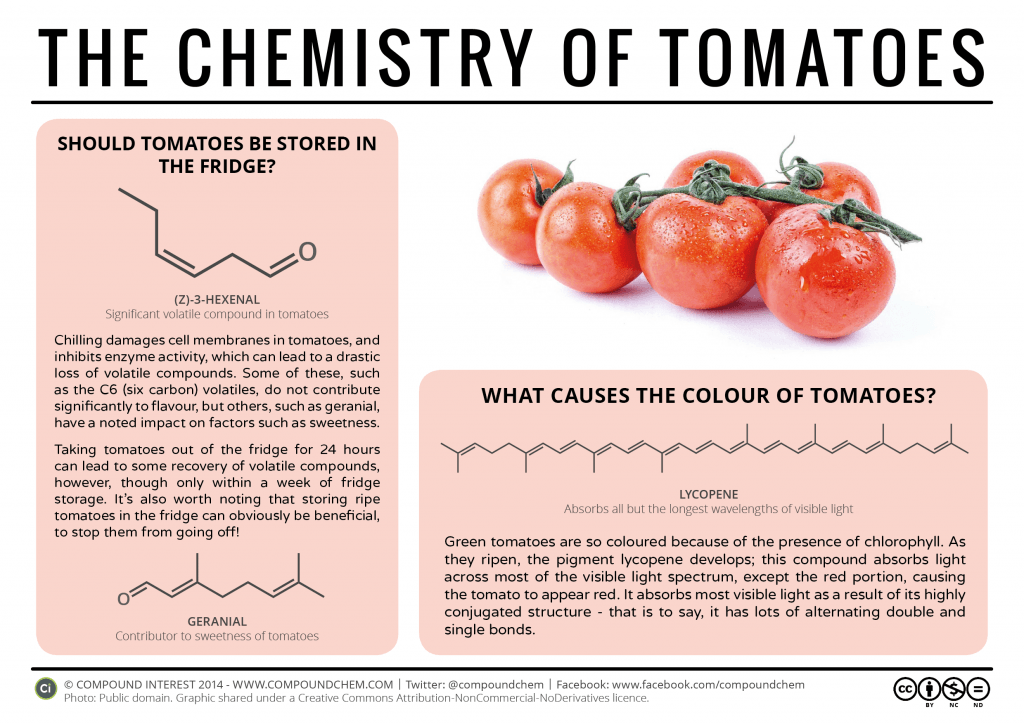
To Refrigerate, Or Not To Refrigerate? – The Chemistry of Tomatoes

You may have previously come across the advice that tomatoes shouldn’t be refrigerated, but should be stored at room temperature, in order to maximise their flavour. To understand the reasoning behind this, we need to take a look at the chemical compounds that give tomatoes their flavour, and the effect that refrigeration has on the production of these.
Let’s first consider the compounds we’re talking about in the first place. Volatile compounds are those that easily evaporate at room temperature, and are responsible for the aromas, and to an extent flavours, of foods. For most foods, a complex mixture of compounds goes into producing the aroma and flavour, and tomatoes are no different. Over 400 volatile compounds have been detected in tomatoes, but of these, researchers have narrowed it down to around 16 key compounds that are associated with flavour and sweetness.
The C6 volatiles (chemical compounds based on six carbons) are known to be the most abundant class of volatiles in tomatoes, but researchers have found that they are not likely to have a significant impact on the flavour of the tomato. With that said, it’s interesting to note that one of the most abundant tomato compounds in this class, (Z)-3-hexenal, is also the chemical compound largely responsible for the aroma of fresh-cut grass. The flavours in tomatoes owe a lot to the presence of sugars such as glucose & fructose, as well as fruit acids, but it’s the effect that chilling has on the volatile compounds that gives weight to the argument for not storing them in the fridge.
A 2013 study found that tomatoes stored at 4˚C showed a drastic decrease in the concentrations of volatile compounds; after 30 days of storage at this temperature, they found that the overall concentration had decreased by 66%. They discovered that the low temperature storage was in particular detrimental to the aroma of the tomatoes, whilst, by contrast, storage at 20˚C resulted in an increase in volatile compound production. The lower volatile compound production at refrigeration temperatures is due to the inhibition of enzymatic activity in the tomato. In theory then, it seems an open and shut case – tomatoes & refrigeration just don’t get along.
However, the study also points out that, for up to a week of storage in the fridge, removing the tomatoes from refrigeration for 24 hours could ‘recondition’ them and increase volatile compound production once again. This was still possible for periods of time longer than a week, but in these cases there remained a discrepancy in the levels of volatile compounds compared to tomatoes at room temperature. Obviously, the refrigeration of tomatoes is often for practical purposes, and it’s doubtless much more conducive to your tomatoes not beginning to rot away if they’re stored in the fridge. It is, however, particularly important not to store tomatoes that are yet to fully ripen in the fridge, as this can slow the ripening process.
In short, the verdict seems to be that you can get away with storing fully ripe tomatoes in the fridge for up to a week to prevent them going off, before then leaving them out for a short time to recover their volatile compound producing ability. Leave them in for longer than a week, and you’re going to be enjoying a less flavoursome tomato!

Source:

Saturday, October 18, 2014

The Planet Needs More Plant Scientists

Academia is not producing sufficient PhDs in the plant sciences to solve the crop production challenges facing a rapidly growing population.
While the message is not new, the declaration of the flaws of the US biomedical research system by four prominent life scientists this spring captured everyone’s attention. Bruce Alberts, Marc Kirschner, Shirley Tilghman, and Harold Varmus wrote in PNAS of how “demands for research dollars grew much faster than the supply . . . [due to] perverse incentives [that] encourage grantee institutions to grow without making sufficient investments in their faculty and facilities.” Rather than devote money to faculty salaries, universities built infrastructure to house more self-paid researchers able to bring in more money via research grants, of which a large fraction was used as revenue (overhead) for the university. More labs required more students to fill them, leading to a dramatic rise of PhDs in the biomedical sciences, which then produced more researchers competing for dwindling grant dollars. In short, research institutions have no incentive to support individual faculty and instead have perverse incentives to encourage further research spending: more grants = more overhead = more buildings = more PIs = more PhDs in an increasingly out-of-control spiral. (See “PhDs in the U.S.”) This is not sustainable, and we are now experiencing the consequences, with the most despairing being the lack of adequate jobs for our postdocs and perceived insufficient funding for all of us.
The unsustainable rate of PhDs awarded per year in the biomedical sciences does not extrapolate to the rate of PhDs in other life sciences, however, especially the agricultural sciences, where the rate of PhDs per year has remained flat for decades. Since 1982, we have consistently trained only about 1,000 PhDs in applied agricultural and related sciences each year. And over the last decade, the U.S. has annually produced only 800 or so plant scientists working in applied agricultural science and only 100 with the skills for basic plant research. (See “Plant science stagnates.”) Given the global agricultural challenges we now face, this is a problem.
The Earth must support another 1 billion humans in the coming decade, and must do so with less arable land and in an unpredictable climate. This means we must find innovative ways to produce crops with higher yields and novel traits—a feat that will require the work of PhDs trained in agriculture and plant sciences. But at this point we are not producing enough plant scientists to lead us out of this Malthusian dilemma.
The US Coalition for a Sustainable Agricultural Workforce recently completed a confidential survey among agricultural biotech companies to ascertain near-term needs for hiring domestic agricultural scientists. This survey generated an amazing result, given the tone of the PNAS perspective, predicting that by 2015, 1,000 new employees will be needed in the half-dozen largest plant-science companies in the US alone (Bayer Crop Science, Dow Agro Sciences, Dupont Pioneer Hybrid, Dupont Crop Protection, Monsanto, and Syngenta). Almost half of these anticipated new hires will hold PhDs. Unfortunately, with what appears to be a dwindling pool of qualified applicants applying to plant science PhD programs, we may not be keeping up with this demand.
The growing world population needs to eat, and it is past due that we elevate basic, translational, and applied plant research to the priority given to biomedical research, or more boldly, to defense. Stabilizing food supplies in a changing environment is integral not only to the world population’s health, as an estimated 50 percent of childhood disease globally is attributed to malnourishment, but also to national security. Moreover, a recent study found that, around the world, the rate of return for investment in agricultural research is ten to one, bringing into question the scaling back of funding for agriculture research and development in many rich countries.
Going forward, we must infuse more resources into plant biology research, to boost research output and to train tomorrow’s plant scientists. In the early 1980s, the National Science Foundation (NSF) established an 11-year postdoctoral fellowship program with the primary objective to nurture future leaders of plant biology research. By many accounts, this program was successful; among a cohort of 236 fellows, four are members of the National Academy of Sciences today, and more than 80 percent remained in plant biology. Of those, the majority stayed in academic institutions, while an impressive number (25 percent) went to industry, where many now hold corporate officer positions. Anticipating the need for leaders to alleviate hunger and to prevent global instability, we should reinstate this program to recruit our best talent to plant science and agricultural research.
In conclusion, it is important that the sirens of a glut of biomedical PhDs do not fallaciously harm other areas of science that are still in desperate need of young researchers and more research funding. This is especially true for the plant sciences, where the next generation of researchers must conquer significant challenges to feed a growing world population in a changing environment.

Source:

Thursday, October 16, 2014

Plant variants point the way to improved biofuel production

Manufacturing biofuels from food crop by-products such as straw could be made quicker and cheaper thanks to a new study led by scientists at the University of York.

The research funded by the Biotechnology and Biological Sciences Research Council (BBSRC) discovered variant straw plants whose cell walls are more easily broken down to make biofuels, but which are not significantly smaller or weaker than regular plants.
The discovery by researchers in the Centre for Novel Agricultural Products at York could help ease pressure on global food security as biofuels from non-food crops become easier and cheaper to make.
The impact of carbon emissions on global warming is driving the need for carbon neutral biofuels. Many existing biofuels are produced from crops which can be used for food, and therefore have a negative impact on global food security.
One answer is to make fuels from woody, non-food parts of plants such as straw. These are rich in polysaccharides (sugar chains) which can be broken down into simple sugars and then fermented into ethanol for fuel. However, such biofuels are currently too expensive because of the cost of digesting the woody tissues into simple sugars.
The CNAP researchers led by Professor Simon McQueen-Mason, working with colleagues in France, screened a large collection of variants of the model grass species Brachypodium for digestibility. Screening mutants in this way allows rapid assessment of the range of natural diversity that can be found in a species.
Using this approach, PhD student Poppy Marriott identified 12 independent plant lines with highly digestible straw, but which grew normally and showed no decrease in straw strength. Analysing these plants showed that increased digestibility can be achieved through a range of changes in the cell wall, where the majority of sugar is contained in woody biomass.
In addition the team at York also showed they can identify the gene alterations that give rise to the high digestibility. The new results are published in the latest edition of the Proceedings of the National Academy of Sciences USA.
By identifying these plant variants with straw that is easier to digest, but which retain their size and strength, the cost and complexity of biofuel production could be reduced.
Professor McQueen-Mason said: “This work sets the stage for identifying similar high-digestibility lines in commercial crop species that will pave the way to more cost-effective and sustainable biofuels.
“Using plant by-products such as straw provides a double benefit as we can harvest the food from the plant, then use the straw to produce a carbon neutral fuel.”
Professor Melanie Welham, BBSRC Executive Director for Science, said: “This research is another important step towards making carbon-neutral biofuels both easier and cheaper to produce. Using crop by-products such as straw for biofuels reduces pressure on food supplies and also adds value to the crop, boosting food security and helping farmers.
“It is just one example of how BBSRC investment in world class bioscience is working towards addressing some of the existing and emerging global challenges that we all face.”

Further information:A range of cell wall alterations enhance saccharification in Brachypodium distachyon mutants is published in Proceedings of the National Academy of Sciences USA.
The Biotechnology and Biological Sciences Research Council (BBSRC) invests in world-class bioscience research and training on behalf of the UK public. Its aim is to further scientific knowledge, to promote economic growth, wealth and job creation and to improve quality of life in the UK and beyond. Funded by Government, BBSRC invested over £484M in world-class bioscience in 2013-14. It supports research and training in universities and strategically funded institutes. BBSRC research and the people it funds are helping society to meet major challenges, including food security, green energy and healthier, longer lives. BBSRC investments underpin important UK economic sectors, such as farming, food, industrial biotechnology and pharmaceuticals.For more information about BBSRC, its science and impact see:http://www.bbsrc.ac.uk For more information about BBSRC strategically funded institutes see: http://www.bbsrc.ac.uk/institutes
The Centre for Novel Agricultural Products (CNAP) is an award winning strategic research centre based in the Department of Biology at the University of York. CNAP is dedicated to realising the potential of plants as renewable, low-cost factories that produce high-value chemicals and biofuels. Laboratory based discoveries are translated into practice in partnership with industry.www.york.ac.uk/org/cnap/

Source:

Tuesday, October 14, 2014

Natural gene selection can produce orange corn rich in provitamin A for Africa, U.S.

Purdue researchers have identified a set of genes that can be used to naturally boost the provitamin A content of corn kernels, a finding that could help combat vitamin A deficiency in developing countries and macular degeneration in the elderly.
Professor of agronomy Torbert Rocheford and fellow researchers found gene variations that can be selected to change nutritionally poor white corn into biofortified orange corn with high levels of provitamin A carotenoids - substances that the human body can convert into vitamin A. Vitamin A plays key roles in eye health and the immune system, as well as in the synthesis of certain hormones.
"This study gives us the genetic blueprint to quickly and cost-effectively convert white or yellow corn to orange corn that is rich in carotenoids - and we can do so using natural plant breeding methods, not transgenics," said Rocheford, the Patterson Endowed Chair of Translational Genomics for Crop Improvement.
Vitamin A deficiency causes blindness in 250,000 to 500,000 children every year, half of whom die within a year of losing their eyesight, according to the World Health Organization. The problem most severely affects children in Sub-Saharan Africa, an area in which white corn, which has minimal amounts of provitamin A carotenoids, is a dietary mainstay.
Insufficient carotenoids may also contribute to macular degeneration in the elderly, a leading cause of blindness in older populations in Europe and the U.S.
Identifying the genes that determine carotenoid levels in corn kernels will help plant breeders develop novel biofortifed corn varieties for Africa and the U.S. The dark orange color of these corn varieties also makes them more culturally acceptable to consumers in African countries where yellow corn is generally fed only to animals, Rocheford said.
Previous research by Rocheford and his colleagues identified two genes that contribute to provitamin A carotenoid levels in corn kernels, but "we wanted more cookies in the jar for breeders to pick from," he said.
The researchers used a combination of statistical analysis and prediction models to identify and assess the potential usefulness of genes associated with carotenoid levels in corn. They evaluated data sets from about 200 genetically diverse lines of corn at varying scopes of investigation - from the entire corn genome to stretches of DNA surrounding small sets of genes. They uncovered four genes that had not previously been linked to carotenoid levels in corn kernels.
Though many genes likely contribute to carotenoid levels in corn, "we're pretty confident that our previous and current research has now identified several genes that are the major players," Rocheford said.
Their study found that a combination of visually selecting corn with darker orange kernels and using a number of these favorable genes could be an effective way to rapidly convert white and yellow corn varieties to orange corn with higher levels of provitamin A and total carotenoids.
"We now have the genetic information needed to begin developing a major public-private sector collaboration with the goal of providing orange corn with high levels of provitamin A to farmers throughout Sub-Saharan Africa," he said.
The study also showed that using a more targeted approach to predicting the usefulness of a small set of genes was as effective as evaluating the whole corn genome, said Brenda Owens, doctoral candidate and first author of the study.
"Having this smaller list of genes to select for means that we can make the improvement of carotenoid levels in corn a simpler, faster process for plant breeders," she said.
Their research - in collaboration with HarvestPlus and the International Maize and Wheat Improvement Center, also known as CIMMYT - has yielded varieties of orange corn with markedly higher amounts of provitamin A carotenoids. But further efforts to produce even higher levels will be necessary to offset degradation of nutrients after harvest and reduce the amount of corn African consumers would need to eat to attain enough provitamin A, Rocheford said.
Varieties of orange corn are currently being grown in Zambia, Zimbabwe, Nigeria and Ghana. An open-pollinated variety of orange corn could be available for organic and local grower operations in the U.S. by 2016, he said.
The paper was published online in Genetics and is available at http://www.genetics.org/content/early/2014/09/25/genetics.114.169979.full.pdf+html
A video presentation of Rocheford discussing the research behind biofortified orange corn and its implications is available athttp://docs.lib.purdue.edu/dawnordoom/2014/presentations/11/
Funding for the research was provided by the National Science Foundation; HarvestPlus; Purdue University startup and Patterson Chair funds; the U.S. Department of Agriculture-Agricultural Research Service; Cornell University startup funds; a U.S. Department of Agriculture National Needs Fellowship; and a Borlaug Fellowship.

ABSTRACT
A foundation for provitamin A biofortification of maize: genome-wide association and genomic prediction models of carotenoid levels
Brenda F. Owens 1; Alexander E. Lipka 2; Maria Magallanes-Lundback 3; Tyler Tiede 1; Christine H. Diepenbrock 4; Catherine B. Kandianis 3, 4; Eunha Kim 3; Jason Cepela 5; Maria Mateos-Hernandez 1; C. Robin Buell 1; Edward S. Buckler 2, 4, 6; Dean DellaPenna 3; Michael A. Gore 4; Torbert Rocheford 1

1 Purdue University, Department of Agronomy, West Lafayette, IN 47907
2 Cornell University, Institute for Genomic Diversity, Ithaca, NY 14853
3 Michigan State University, Department of Biochemistry and Molecular Biology, East Lansing, MI 48824
4 Cornell University, Department of Plant Breeding and Genetics, Ithaca, NY 14853
5 Michigan State University, Department of Plant Biology, East Lansing, MI 48824
6 United States Department of Agriculture-Agricultural Research Service (ARS), Robert W. Holley Center for Agriculture and Health, Ithaca, NY 14853

Efforts are underway for development of crops with improved levels of provitamin A carotenoids to help combat dietary vitamin A deficiency. As a global staple crop with considerable variation in kernel carotenoid composition, maize (Zea mays L.) could have widespread impact. We performed a genome-wide association study (GWAS) of quantified seed carotenoids across a panel of maize inbreds ranging from light yellow to dark orange in grain color to identify some of the key genes controlling maize grain carotenoid composition. Significant associations at the genome-wide level were detected within the coding regions of zep1 and lut1, carotenoid biosynthetic genes not previously shown to impact grain carotenoid composition in association studies, as well as within previously associated lcyE and crtRB1 genes. We leveraged existing biochemical and genomic information to identify 58 a priori candidate genes relevant to the biosynthesis and retention of carotenoids in maize to test in a pathway-level analysis. This revealed dxs2 and lut5, genes not previously associated with kernel carotenoids. In genomic prediction models, use of markers that targeted a small set of quantitative trait loci (QTL) associated with carotenoid levels in prior linkage studies were as effective as genome-wide markers for predicting carotenoid traits. Based on our GWAS, pathway-level analysis, and genomic prediction studies, we outline a flexible strategy involving use of a small number of genes that can be selected for rapid conversion of elite white grain germplasm, with minimal amounts of carotenoids, to orange grain versions containing high levels of provitamin A.

Source:

Sunday, October 12, 2014

Prosopis: A global assessment of the biogeography, benefits, impacts and management of one of the world’s worst woody invasive plant taxa

Invasive species cause ecological, economic and social impacts and are key drivers of global change. This is the case for the genus Prosopis (mesquite; Fabaceae) where several taxa are among the world’s most damaging invasive species. Prosopistaxa are currently naturalised or invasive in 103 countries and are bioclimatically suitable for many more. There are numerous management practices available to control Prosopis invasions, each with their benefits and costs, however, in most areas management has had only limited success. In a new article published in AoB PLANTS, Shackleton et al. present a global review of Prosopis, focusing on its distribution, impacts, benefits and approaches to management. Key gaps in knowledge and promising options for management are highlighted.

Source: